
Building a modern laboratory is a comprehensive systems engineering project. While equipping the facility with various instruments and supporting infrastructure, it is essential to consider not only requirements for power supply, water supply, drainage, air supply, exhaust ventilation, purification, and wastewater disposal, but also safety for personnel, materials, and the surrounding environment; comfort in terms of noise, odors, and visual environment; the operability and functionality of instruments and equipment; and the convenience of information processing. Therefore, a modern biochemistry laboratory must be equipped with optimal design and high-quality equipment to meet these requirements.
Modern laboratory equipment includes fume hoods, central laboratory benches, side benches, chemical storage cabinets, glassware cabinets, and gas cylinder cabinets. Among these, fume hoods play a crucial role and are indispensable pieces of laboratory equipment.
I. Main Functions of Fume Hoods
The primary function of a fume hood is exhaust ventilation. In laboratories, experimental procedures generate various harmful gases, odors, moisture, as well as flammable, explosive, and corrosive substances. To ensure user safety and prevent the spread of contaminants from experiments into the laboratory, fume hoods must be used near the source of contamination. In the past, fume hoods were used sparingly, primarily for experiments involving particularly harmful and dangerous gases or those generating large amounts of heat. Fume hoods originally served only as auxiliary equipment for laboratory benches. In recent years, however, to improve the laboratory environment, experiments previously conducted on laboratory benches have gradually been moved into fume hoods. This shift requires fume hoods to be equipped with features best suited for the equipment used. Given the critical role fume hoods play in biochemistry laboratories—and considering the need to improve the laboratory environment, enhance occupational health conditions, and increase work efficiency—the number of fume hoods in use has increased dramatically. Consequently, ventilation ductwork, piping, wiring, and exhaust systems have all become critical considerations in laboratory construction.
The primary purpose of using fume hoods is to exhaust harmful gases generated during experiments and protect the health of laboratory personnel. In other words, they must offer a high level of safety and superior operability, which requires fume hoods to possess the following functions:
1. Exhaust Function: The fume hood should be capable of diluting harmful gases generated inside the hood by drawing in air from outside the hood and then exhausting them outdoors.
2. Backflow Prevention: The fume hood must prevent the airflow generated by the exhaust fan inside the hood from causing harmful gases to flow back into the room. To ensure this function, the best method is to connect a single fume hood to a single exhaust fan via a single duct. If a single duct connection is not possible, connections are limited to parallel connections within the same room on the same floor; the exhaust fan should be installed at the end of the duct (or at the ceiling level) whenever possible.
3. Isolation Function: A non-sliding glass window at the front of the fume hood should separate the interior from the exterior.
4. Air Make-Up Function: The fume hood should be equipped with a duct or alternative device to draw in air from outside the hood while exhausting hazardous gases.
5. Heat Resistance and Acid/Alkali Corrosion Resistance: Some fume hoods are designed to accommodate electric furnaces, while certain experiments generate large quantities of toxic and hazardous gases—such as acids and alkalis—that are highly corrosive. The worktop, lining, side panels, and selected water and gas outlets of the fume hood must all be corrosion-resistant. In the semiconductor industry or during corrosive experiments involving strong acids such as sulfuric acid, nitric acid, and hydrofluoric acid, the fume hood’s entire structure must be resistant to acids and alkalis. Fume hoods can be classified by usage type into floor-standing, tabletop, and standard models.
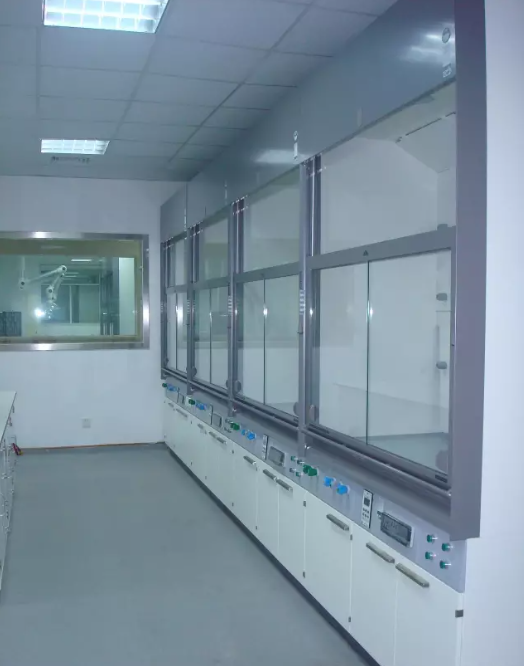
II. Safety Is the Primary Objective of Fume Hoods
Safety is the primary objective of fume hoods; their use in laboratories is intended to ensure the safety of users and prevent contamination of the surrounding environment.
These safety features are primarily reflected in the following:
1. A unique exhaust structure is employed to effectively remove harmful gases.
2. The fume hood can be positioned at any height without fixed stops, meeting experimental requirements.
3. The glass window is made of tempered glass; even if the glass is accidentally broken or shatters, it will not cause injury.
4. Ventilation openings are installed at the top of the fume hood, allowing air to enter even when the glass window is closed, thereby preventing the buildup of excessive negative pressure.
5. The fume hood enclosure is constructed of metal or other materials, while the interior is lined with Antibacterial Board, stainless steel, or other flame-retardant or non-combustible materials. The worktop is made of solid chemical-resistant laminate or stainless steel, providing resistance to acids and alkalis, heat resistance, and flame retardancy.
6. The worktop is 800 mm high, designed for ergonomic comfort and ease of operation. It offers ample workspace and enhances safety.
III. Safety Precautions Must Also Be Observed When Using Fume Hoods
1. Before beginning an experiment, ensure that the fume hood is operational before proceeding with any experimental procedures.
2. Allow the fume hood to continue running for at least 5 minutes after the experiment has ended before turning it off to expel any residual gases from the ductwork; keep the front sash closed as much as possible during this time.
